Care in Co-Production
On the recent 2026 CATER School in Madagascar, a group of both participants & staff spent an evening reflecting on the concept of 'care' in co-production. This blogpost is the outcome of that important reflection, and a contribution to a conversation that is too often ignored.
What would it mean to have a science that positions care at its core? Does care have a place in transdisciplinary practices? And how does care redefine (scientific) knowledge production? We dedicated an evening at the third CATER School to a conversation about care. The overall spirit of the CATER School is to centre more inclusive and socially engaged science and to bridge the gap between interdisciplinary, socio-economic, cultural and lived experiences on climate change and action. The endeavor to bridge climate research to action, to engage with different ways of knowing and differently situated peoples, could benefit from a practice of care. The CATER school included climate and transdisciplinary researchers, and practitioners engaged in these fields, from across the world. In this blog, we share the rich insights from our conversation about care in co-production.
We started from a philosophical notion of care, which theorizes dimensions of attentiveness, reciprocity, maintenance and repair (see Ressiore et al. 2025). Theories on care invite us to be aware of and restructure power relations, challenge norms of “fast science” and dominant paradigms of autonomy, individuality and reason. More specifically, care means being attentive to whose knowledge counts, whose voice is heard, and whose interests and needs are presented (or not). It centers reciprocity and interdependence in relations across species, communities and ecosystems, and considers different ways of knowing equally. Care sustains and repairs these relations and practices.
We then moved from the more theoretical stance to reflect on care as an intuition, a stance, a choice. It is from this intuitive notion of care that we organised the conversation. We invited people to take the practice of care as something that is felt before it is defined: as an act of noticing, feeling, standing in relation, and resisting. To have a dialogue on care, we took care of the space we created. We formed a circle. We communicated our intention for people to feel safe, to decide what (not) to share, to listen attentively, without interrupting. We asked for consent from everyone to write on this process.
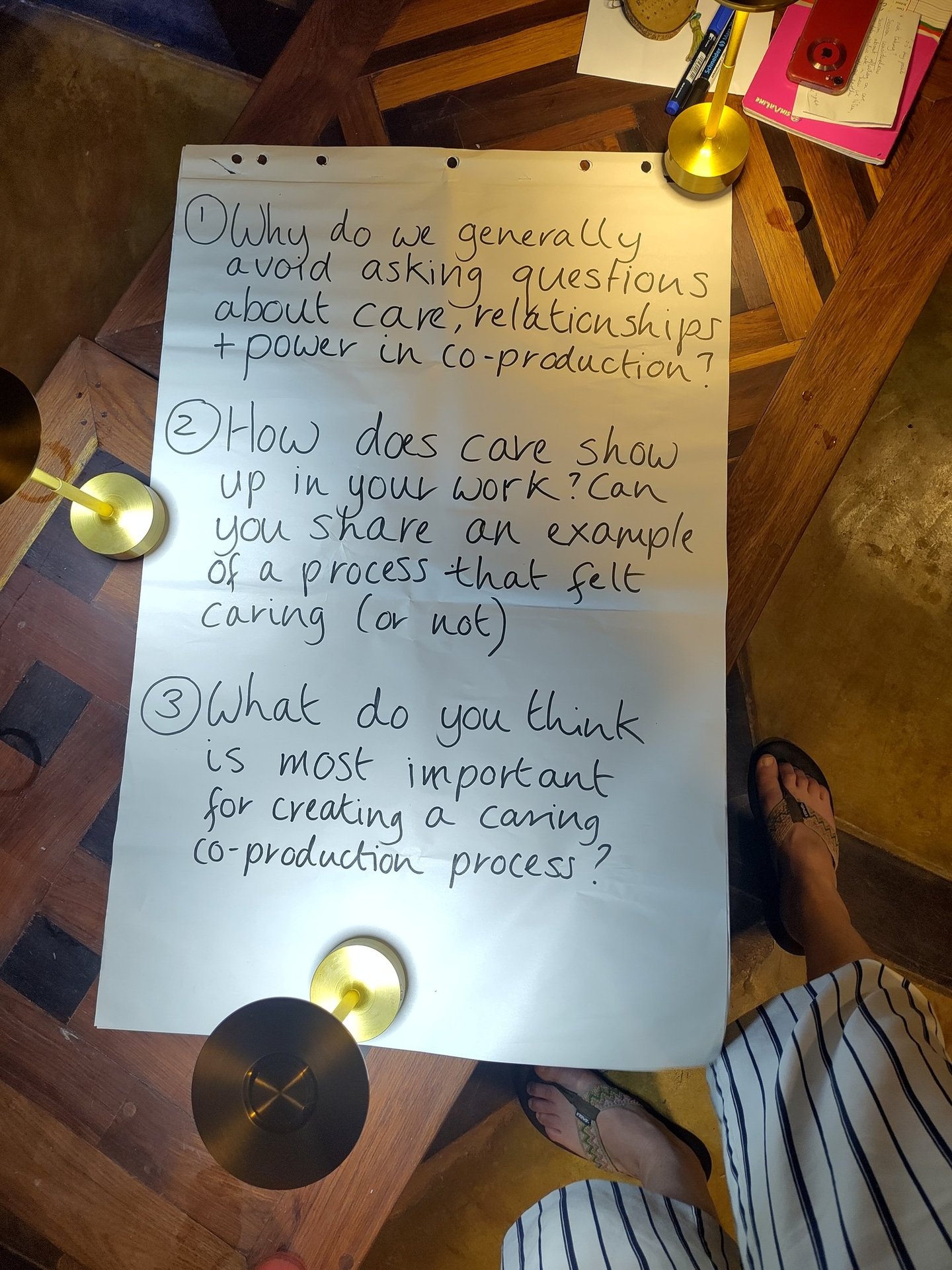
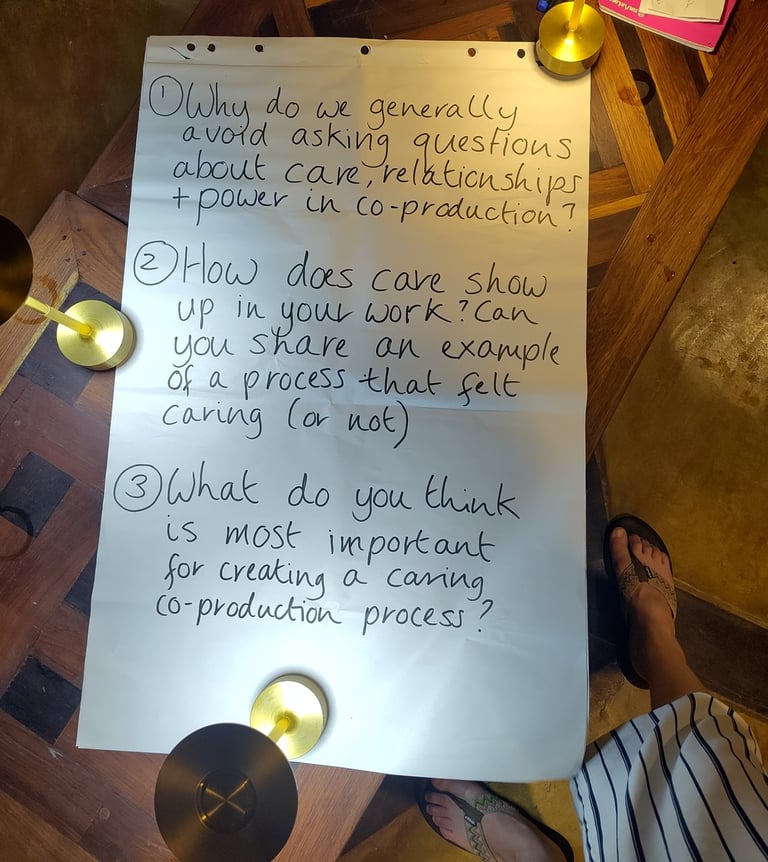
The conversation was structured around three questions.
Why do we generally avoid asking questions about care, relationships, and power in co-production?
How does care show up in your work? Can you share an example of when a process felt caring, or not?
What do you think is most important for creating a caring co-production process?
After 10 minutes of quiet individual reflection on the questions, we shared our thoughts in a circle and transitioned into an open dialogue.
Why do we generally avoid asking questions about care, relationships, and power in co-production?
Conversations on care come with a certain kind of discomfort: we are not used to it, we are used to distance. The discomfort of addressing care stems from the inevitability to speak about privilege, power, extractivism and colonialism in research. Many of us avoid these conversations because we fear opening a “can of worms” that we don’t know how to manage. There is a sense that if we don’t ask the question, the problem doesn’t exist. Furthermore, we often lack the specific vocabulary or expertise to navigate these complex emotional and societal issues.
Some suggested that this avoidance or discomfort is baked into the ways we structure our work environment: there is a taboo around sharing anything “private” in a professional setting, or ideas that care belongs to personal relationships. Consequently, many researchers don’t avoid care out of malice; they simply haven’t been exposed to the idea that care is a valid, or even necessary, component of science. For example, when a project starts, the first meetings are often via Teams with a set agenda and very little space for getting to know each other, sharing our backgrounds and biases, more personal aspects of who we are, where we are speaking from or how we are feeling.
The dismissal of care in our workspaces is part of the capitalist and patriarchal culture in which we live. In these cultures, efficiency, strength and strict time management are cherished while care and relationality are often dismissed as weak. This is also reflected in the assumption that science deals with objective truths and rationality, which further exacerbates the divide between work and personal spaces. Perhaps we avoid asking questions about care because of cultural norms and the standardization of capitalist values.
Detachment or being able to afford not to care could go hand in hand with privilege. In co-production practices, for instance, care comes together with accountability. When we work in a community that isn’t our own, it is easy to maintain distance and to extract knowledge without the burden of being accountable. In our own community, we would “go the extra mile,” because the personal attachment to the people, place and context makes you care. Concerns were raised about whether bringing these questions into co-production will lead to unmanageable expectations, or will conflict with predefined agendas that funders demand. Bringing care into science or institutional spaces is difficult because the stakes are high: it requires us to question the very rules we have built for ourselves; rules or assumptions such as the prioritization of output over people or giving up one’s privilege. It is furthermore difficult to introduce care into institutions that don’t take care of us.
How does care show up in your work? Can you share an example of when a process felt caring, or not?
Someone described bringing care in the workspace as revealing the “elephant in the room,” namely inviting one’s personal context, feelings, emotions, and concerns into the workspace. To bring your full self to work, the workspace needs to be caring too. Therefore, including care asks for reflexivity and attentiveness. It could mean creating a space where ideas are considered welcome, safe, free of the fear of being judged, making space to be expressive and to respect one’s particular background and context. Building a careful and safe research group does not only increase one’s wellbeing, but can have positive influences on the work you do. Careless environments consume a lot of emotional energy and cognitive resources that could instead be used to support quality of work and relationships. People expressed that creating caring work environments is difficult and time consuming, especially in scientific and male-driven contexts.
Another way of bringing care into work is by placing the question of social justice at the core. One of the participants shared reflections on how he is driven by care to provide pro bono work for young entrepreneurs. Care thus serves as a tool for social balance. Bringing care in the legal context can close gaps in the process, for instance, by truly taking time to understand the people involved or by supporting the most vulnerable groups. In this way, care could serve as a transformative social practice.
Finally, a participant offered the perspective that care can be contextual, role-dependent and mismatched between different groups; what feels like care in Norway might look different in Madagascar according to this line of thinking. There are, for instance, differences between formal and informal forms of care. When you live in a country with a high level of formal care (e.g. good working conditions or social security), the need for informal care at the workplace might be lower. Another example was raised from a project where Global North researchers requested access to rain gauge data from National Meteorological Services based in the Global South. The researchers' intention is to improve the forecasts, which is their expression of care. However, such data are a form of wealth for the National Meteorological Services and they most often have a hard limit on how much data can be shared. They care about these data in different ways. Both the researchers and the National Meteorological Services care, but diverse contexts and interests lead to some kind of mismatch. Examples of such conflicts of care were also provided from the CATER school. For instance, questions were raised about whether one shows care by ending a meeting on time to respect people’s schedules, or by running over to ensure voices and concerns are heard. Another participant reflected on the potential carelessness of developing a serious game (an important part of the CATER school), which is meant to be playful but is dealing with potentially very harmful and painful weather events and social situations. Thus, caring is not static, it is a constant negotiation of what care looks like in specific social processes.
What do you think is most important for creating a caring co-production process?
Co-production is a social process that is concerned with societal challenges and involves differently situated actors (e.g. researchers, practitioners, NGOs, states, …), with different interests at stake. Reflecting on care in this very process is necessary to avoid repeated violence in co-production, or sharply said, co-destruction.
Building trustworthy relationships is one of the most important aspects of co-production processes. This involves active listening, which is listening to understand rather than to respond. Active listening can create an environment of emotional safety, where people feel accommodated. Building relationships implies investing time in getting to know people, their context, their needs. This often happens informally, by drinking coffee together or taking a walk, which makes people feel seen. In getting to know each other, we need to make the values, backgrounds, biases and assumptions from which we speak explicit and bring them into the co-production process. This also involves a dialogue about systemic and interpersonal oppressions that can “slip into” co-production and are well-known in the history of research.
Care is also giving credit to the knowledge and time of people in communities that are part of the co-production process. This could be in the form of co-authorship or producing output that is relevant for the community, such as in the form of stories, podcasts, reports or art. This is an act of reciprocity: by not just being a sponge and collecting the knowledge you need, but instead recognize the contribution of communities and give something back.
An important attitude for researchers who want to co-produce research and action, is honesty. It is asking questions such as: why am I involved in this? Is this for my career? Or for the wellbeing of different communities? Would I still engage if it didn’t progress my career? It is an opportunity to investigate one’s intentions. This brings us back to the notion of accountability. When we work in contexts where we do not feel accountability (i.e. in context and community that are not our own), what happens when the project ends? What does the notion of care mean for choosing to do research in a community or context that is not our own? Should we prioritize working in our own back yards? These questions are tricky, but worth thinking about.
To end with, navigating care in co-production processes can be difficult and challenging. It asks for making the unsaid said, for giving up privilege and being vulnerable, for becoming an attentive listener and honest speaker. Reflexivity is critical for caring co-production. Processes might also benefit from an independent facilitator who has expertise and understands violence in relationships and social processes, the right tools to address these issues, and to moderate co-production processes accordingly.
Acknowledgement: Thank you to all the participants for dedicating their evening sharing, thinking and feeling about care. It was truly meaningful and important. Thank you to Rondrotiana Barimalala and Jesse Schrage for the helpful comments on the text.