
Fourth School
Our fourth school will be held from 19th to 29th April 2027 in Thyolo, in southern Malawi. The venue is Game Haven Lodge, situated in Chimwenya Game Park. The school is co-organised with the ARCS research project. Applications are now closed.


The CATER–ARCS School: Climate Risk Adaptation in Action
We’re excited to announce the 2027 CATER School, the fourth in a series of immersive, transdisciplinary schools about adapting to climate risk! This year’s edition will take place in Malawi 19th - 29th April 2027, jointly organised with the NORAD-funded Agricultural Resilience through Climate Services (ARCS) project.
The fourth School follows successful previous iterations in Kenya in 2023, Tanzania in 2024, and Madagascar in 2026. You can read more about these by following the links across this website.
What to expect?
Each CATER school convenes participants and staff for 10 working-days of intensive and participatory learning, blending lectures, plenaries, and hands-on learning focused on real-world case studies of climate risk. This year, the case study context in focus is Malawi (one of the partner countries in the ARCS project). Included also is a School-long group work project where participants co-develop a ‘serious game’, helping in the interconnected, transdisciplinary, exploration of climate risk. This combined pedagogical approach will ensure participants gain both theoretical knowledge and practical skills.
Key themes will include:
✅ An introduction to ‘transdisciplinarity’, and the role of transdisciplinary approaches in climate risk research and practice
✅ Foundational physical climate drivers, climate forecasting, and Malawian climate dynamics.
✅ Advances in sub-seasonal forecasting and AI in climate services.
✅ Climate risk decision complexity and plural knowledge systems.
✅ Governance, ethics and justice in climate adaptation and services.
✅ Co-production and community-led responses in adaptation.
✅ Impact assessments and evaluation of climate services.
Importantly, although the 2027 School takes Malawi as its geographical focus, the Schools are designed for postgraduate students, postdocs, early-career researchers, and practitioners (e.g. from government agencies, NGOs, or the private sector) from diverse disciplinary and geographical backgrounds who collectively want to deepen their understanding of, and capabilities with, transdisciplinary approaches for navigating complex climate risks. Therefore, we welcome applicants working across varied contexts of climate risk - including beyond Africa.
Who could apply?
The school is designed for postgraduate students, postdocs, early-career researchers, and practitioners (e.g. from government agencies, NGOs, or the private sector) from diverse backgrounds who want to deepen their understanding of, and capabilities with, transdisciplinary approaches for navigating complex climate risks. We aim for a cohort which is balanced in terms of geography (50/50 from Africa and beyond), skills/professions, disciplines, and gender.
Each CATER School is highly oversubscribed, so the participant cohort selection process is competitive. We may contact individual applicants for more information to help with our selection process if required.
IMPORTANT NOTE ON AI USE IN APPLICATIONS: In its selection process, CATER School deliberately aims to bring together a highly motivated cohort with a diverse set of perspectives and experiences on climate risk. Applicant responses written using Large Language Models (such as ChatGPT) are easy to identify, lacking the individuality of perspective and specific motivations that we so highly value. We strongly recommend AI use is limited only to basic grammar/spell checking functions. Identified AI usage beyond this will therefore be taken into account within the selection process.
Cost
The participation fee is €500, covering accommodation, meals at the School, field trips, and airport transfers. Participants must cover their own travel expenses to and from Malawi, as well as visa and insurance costs.
However, applicants from low- and middle-income countries may apply for a travel stipend and/or fee waiver via the application form.
A unique collaboration
This year’s school is a joint effort between CATER and ARCS, a major transdisciplinary research and development project working to improve climate services, decision-making, and resilience strategies in Malawi and Ethiopia. By linking with ARCS, we ensure strong links to real-world challenges, local expertise, and the latest scientific advancements. More information about the ARCS project can be found here: https://arcs-resilience.org/about-arcs
Practical details
The course is conducted in English. The school has a mix of lectures, project assignments, activities, free time and outings. 100% attendance is expected during the whole School and across 2 remote engagements before and after.
The course venue is Game Haven Lodge, near Thyolo - just south of Blantyre in Malawi. Accommodation at the course venue for all participants is in shared twin rooms.
All students must be in place by the evening of Sunday, 18th April. The school will end on Thursday, 29th April.
Upon completion of the CATER School participants are awarded a certificate, certificating participation in 65 hours of learning and practical skills building. For those collecting ECTS as part of an academic program, this translates to approximately 5 ECTS upon the submission of the CATER School certificate to your respective institutions. N.B.: Different institutional requirements may cause some variation.
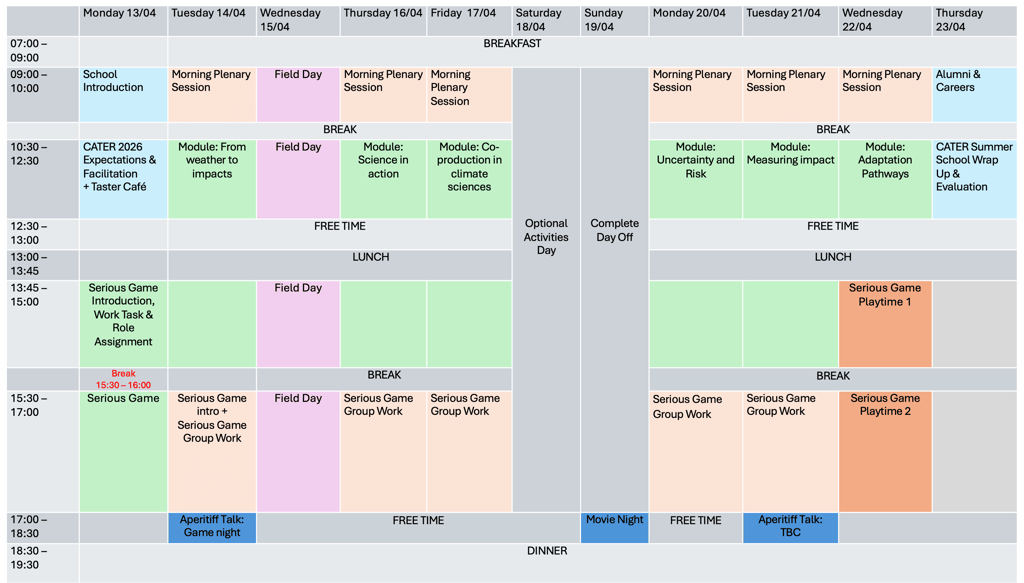
2026 Schedule as a template for what to expect in 2027!
Draft School topics 2027 - to be confirmed:
An introduction to changing climatic risk, with an emphasis on Malawi
Climate science, climate prediction, and uncertainty
Co-production of climate services
Climate vulnerability and adaptation options through transdisciplinarity
Complexity of decision-contexts and the plurality of knowledge in climate adaptation
Use of game-based participatory methods in climate adaptation learning and decision-making
Approaches and methods for impact assessment and evaluation of climate services
Lecturers - TBC
Stay tuned...